

















If you are planning to replace missing teeth with dental implants, you may come across two common options: basal implants vs conventional implants. Both treatments are used in implant dentistry, but they work in different ways and are recommended for different situations.
Many patients visiting our dental clinic in Rajkot often ask the same question: Which implant is better, basal implants or conventional implants?
The answer depends on several factors like bone quality, treatment time, and overall dental health. In this guide, we will explain the difference between basal implants and conventional implants, how each procedure works, and how to decide which one might be suitable for you.
What Are Conventional Dental Implants?
Conventional implants are the most commonly used dental implants worldwide. These implants are placed into the jawbone where a tooth is missing.
After the implant is placed, the bone gradually grows around it and forms a strong connection. This process is called osseointegration, which allows the implant to become firmly attached to the jawbone.
Because the bone needs time to heal and integrate with the implant, the full treatment usually takes three to six months before the permanent crown is placed.
Main Features of Conventional Implants
- Placed in the alveolar bone (the softer part of the jawbone)
- Require healing time of several months
- Often involve a two-stage procedure
- Sometimes require bone grafting or sinus lift surgery
- Provide strong and long-term stability
Conventional implants are widely used because they have predictable long-term results and are supported by decades of clinical research.
What Are Basal Implants?
Basal bone remains strong even when teeth are missing for a long time. Because of this, basal implants can be used even when patients have significant bone loss.
Another key difference is the treatment speed. In many cases, teeth can be attached to basal implants within 48–72 hours, which means patients can receive fixed teeth much faster.
Main Features of Basal Implants
- Placed in dense cortical bone
- Often a single-piece implant design
- Teeth can be fixed within a few days
- Usually no bone grafting required
- Suitable for patients with bone loss
Because of these advantages, basal implants are sometimes recommended for patients who cannot receive traditional implants due to bone loss.
Basal Implants vs Conventional Implants: Key Differences
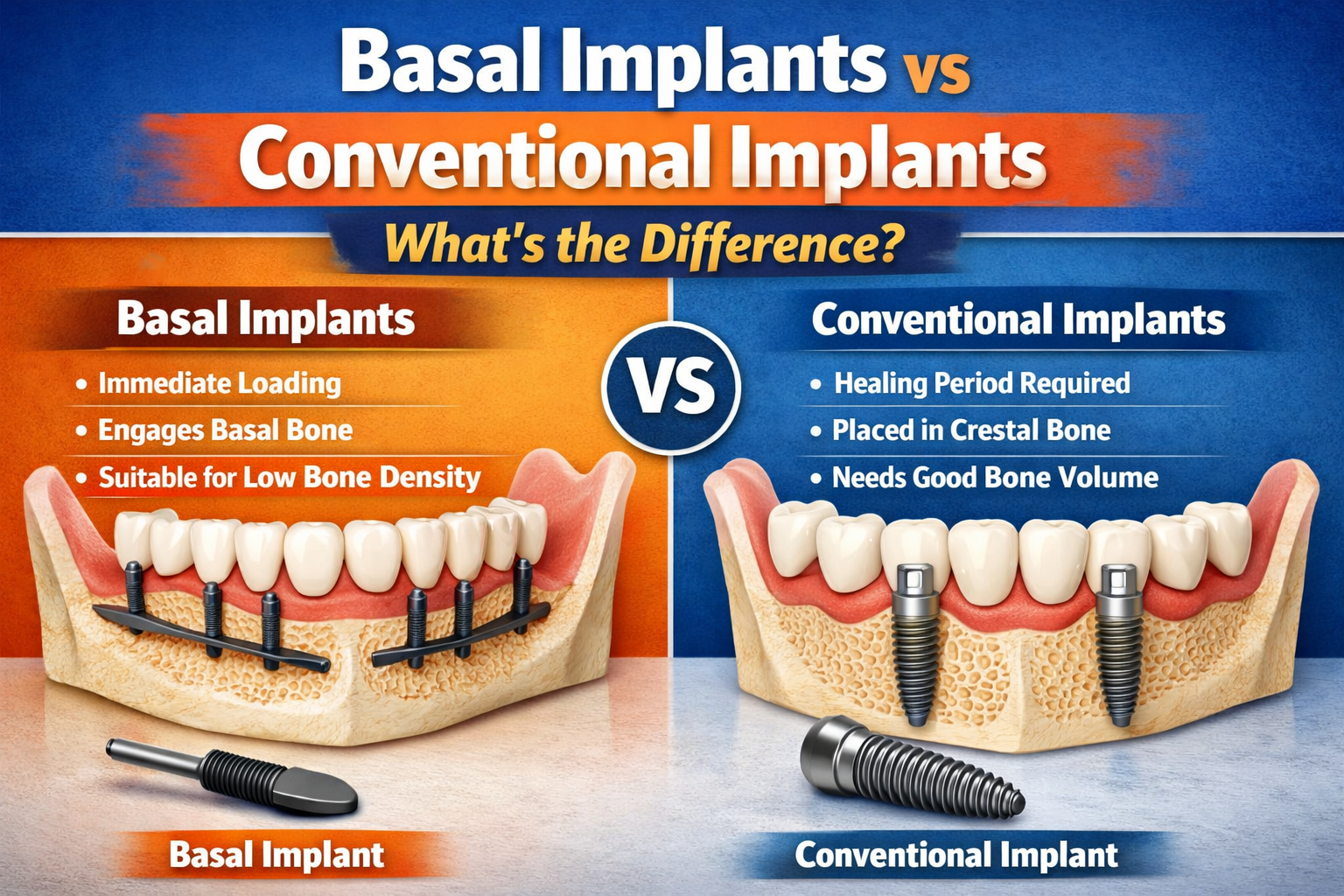
Here is a simple comparison to understand the difference between basal implants and conventional implants.
1. Bone Used for Implant Placement
One of the biggest differences is the type of bone used.
Conventional implants are placed in the spongy alveolar bone, which may shrink after tooth loss. Basal implants, on the other hand, are anchored in the strong cortical bone, which is more stable and less likely to shrink.
Because cortical bone remains strong for longer periods, basal implants can work even when the jawbone has reduced significantly.
2. Treatment Time
Another major difference between basal implants and conventional implants is the treatment duration.
Conventional implants usually require three to six months of healing before the crown can be placed.
Basal implants allow immediate loading, meaning teeth can often be fixed within two to three days after the implant surgery.
For patients who want faster results, basal implants may be an attractive option.
3. Need for Bone Grafting
Many patients with missing teeth experience bone loss over time.
In such cases, conventional implants may require procedures like:
- Bone grafting
- Sinus lift surgery
These treatments help rebuild the bone before implant placement.
Basal implants usually do not require bone grafting because they are anchored in deeper, stronger bone layers.
This can reduce both treatment time and cost.
4. Implant Design
Conventional implants usually have a two-piece design, consisting of:
- Implant screw
- An abutment that connects to the crown
Basal implants are often single-piece implants, where the implant and abutment are part of the same structure.
This design allows faster placement and immediate loading of teeth.
5. Stability and Integration
Conventional implants depend on osseointegration, which means the bone cells grow around the implant and create a biological bond.
Basal implants rely more on mechanical fixation in the cortical bone.
Both approaches can work well when done by experienced implant dentists, but they function differently.
Advantages of Conventional Implants
Conventional dental implants remain the standard treatment in implant dentistry for many reasons.
Benefits include:
- Long-term stability
- Natural look and feel
- Strong chewing ability
- Easy repair if needed
Because the implant integrates biologically with the bone, it often provides very reliable long-term results.
Advantages of Basal Implants
Basal implants also offer several benefits, especially for specific patients.
Advantages include:
- Faster treatment time
- Immediate fixed teeth
- No bone grafting required
- Suitable for patients with bone loss
- Fewer surgical procedures
For patients who want a quick tooth replacement solution, basal implants may be a practical option.
Which Implant Is Better?
There is no single answer to whether basal implants vs conventional implants are better.
The right option depends on:
- Bone condition
- Number of missing teeth
- Overall oral health
- Budget and treatment timeline
For example:
- Patients with good bone density may benefit from conventional implants.
- Patients with severe bone loss may be better candidates for basal implants.
A qualified implant dentist will examine your jawbone using X-rays or scans before recommending the right treatment.
Frequently Asked Questions
What is the difference between basal implants vs conventional implants?
Basal implants are placed in the strong cortical bone and allow faster treatment, while conventional implants are placed in the jawbone and usually require several months of healing.
Which implant is better, basal implants vs conventional implants?
Both have benefits. Conventional implants are widely used with proven long-term results, while basal implants are useful for patients with bone loss.
Do basal implants require bone grafting?
In most cases, basal implants do not require bone grafting because they are anchored in deeper and stronger bones.
How long do conventional dental implants take?
Traditional dental implant treatment usually takes 3–6 months for the implant to integrate with the bone.
Choosing the Right Dental Implant in Rajkot
If you are considering dental implants in Rajkot, the most important step is choosing an experienced dentist who understands the difference between basal implants vs conventional implants.
A proper consultation should include:
- Detailed oral examination
- Jawbone scan
- Discussion about treatment options
- Cost and timeline explanation
This helps ensure you receive the implant treatment that best suits your needs. Our team at Harsha Dental and Facial Surgical Hospital, Rajkot will examine your bone condition and explain the difference between basal implants vs conventional implants and help you choose the treatment that suits you best.
Clear guidance. Transparent treatment options. Experienced dental care.
If you’re considering dental implants in Rajkot, you can call us or visit the clinic to schedule a consultation.